The Complete Drone LiPo Battery Care Guide: Charging, Storage, Lifespan & Swelling Prevention
The Complete Drone LiPo Battery Care Guide: Charging, Storage, Lifespan & Swelling Prevention starts with one simple rule: treat every battery as a heat-sensitive power source. Correct charging, storage voltage, temperature control, and regular inspection protect both your drone and your home. A swollen or damaged pack needs different handling from a healthy one.
A standard LiPo cell charges to 4.2 volts, while storage usually sits around 3.7 to 3.85 volts per cell. Those numbers guide nearly every safe decision. As of 2026, manufacturer instructions remain the final authority for battery limits, so let’s start with the care rules that prevent most failures.
The Complete Drone LiPo Battery Care Guide: Charging, Storage, Lifespan & Swelling Prevention
The Complete Drone LiPo Battery Care Guide: Charging, Storage, Lifespan & Swelling Prevention begins with safe charging and inspection. Use the correct charger, chemistry, cell count, and current. Store packs near 3.7 to 3.85 volts per cell.
Retire batteries showing swelling, leakage, serious damage, or unstable voltage.
Never charge a damaged LiPo battery. Keep charging supervised on a nonflammable surface. Let hot packs cool before charging, and use storage mode during extended breaks.
Drone LiPo Battery Care: The Rules That Prevent Most Failures
Drone LiPo batteries deliver high current through lightweight lithium-polymer cells. That power suits FPV drones and camera drones, but it leaves little room for careless charging or deep discharge. A battery can look normal while developing imbalance, rising internal resistance, or hidden crash damage.
Follow this basic decision path:
- If the battery is swollen, punctured, leaking, or badly crushed, do not charge or fly it.
- If the pack is hot from flight, let it return near room temperature first.
- If the pack is healthy, confirm its chemistry and cell count.
- If you won’t use it for several days, select storage charge.
- If one cell differs sharply from the others, stop and investigate.
A battery fire can spread quickly. Charge where smoke, heat, or flames won’t reach curtains, paper, fuel, or other batteries. Don’t leave a charging pack unattended, even if the charger has automatic shutoff.
Your normal care routine should include four checks:
- Inspect the shell, wires, connectors, and balance lead.
- Check individual cell voltages before charging.
- Monitor pack temperature during charging and flight.
- Record unusual short flight times, swelling, or voltage sag.
Manufacturer specifications indicate that charging limits vary between standard LiPo, LiHV, and smart battery systems. Don’t apply a 4.35-volt LiHV setting to a standard 4.2-volt LiPo pack. That mistake can cause permanent damage or a serious fire risk.
How Drone LiPo Batteries Work and What the Numbers Mean
A drone LiPo battery contains two or more lithium-polymer cells connected in series. A 4S pack has four cells, so its nominal voltage is about 14.8 volts. Its full-charge voltage is 16.8 volts because each cell reaches 4.2 volts.
| Battery rating | What it tells you | Example |
|---|---|---|
| Cell count | Number of cells in series | 4S means four cells |
| Capacity | Stored charge | 1,500 mAh |
| C-rating | Advertised discharge ability | 50C |
| Nominal voltage | Approximate operating voltage | 3.7 V per cell |
Capacity appears in milliamp-hours, or mAh. A 1,500 mAh pack can theoretically provide 1.5 amps for one hour under specified conditions. Drone loads change constantly, so real flight time depends on throttle use, propellers, aircraft weight, wind, and battery condition.
The C-rating estimates how much current a battery can deliver. A 1,500 mAh, 50C pack has a theoretical continuous rating of 75 amps, calculated as 1.5 multiplied by 50. Treat that figure as a manufacturer rating, not a guarantee of identical real-world performance.
Internal resistance gives a better picture of aging. As resistance rises, more energy turns into heat and voltage drops faster under throttle. That voltage drop is called voltage sag.
Excessive sag can cause weak acceleration, early low-voltage warnings, or an unexpected landing.
Standard LiPo and LiHV packs are not interchangeable in charger settings. Standard LiPo cells reach 4.2 volts. LiHV cells can reach 4.35 volts when the manufacturer specifically supports that chemistry.
Smart batteries may also contain monitoring electronics, firmware, and protection circuits, but they still need the approved charger and storage procedure.
Before You Charge: Inspect the Battery and Confirm the Settings
Start every charging session with a physical inspection. Look for puffing, dents, cuts, exposed conductors, loose wires, melted plastic, damaged connectors, or a torn balance lead. A hard landing can damage internal layers even when the outer wrapper looks mostly intact.
A healthy pack should have a firm, even shape. Minor surface softness does not automatically prove danger, but visible expansion is a stop signal. Don’t press a swollen pack flat, pierce it, tape it tightly, or place it back into service.
Check the battery label before connecting it. Confirm these details:
- Chemistry, such as LiPo or LiHV
- Cell count, such as 3S or 6S
- Capacity in mAh
- Maximum charge rate
- Correct main connector
- Correct balance connector
The charger must match both the chemistry and cell count. If the label says 4S LiPo, choose 4S LiPo balance charging. Don’t guess from connector size or physical shape.
After connecting the balance lead, read each cell separately. Healthy cells should sit close together, especially after resting. A large difference suggests imbalance, damage, a poor connection, or an inaccurate reading.
Stop charging if the charger reports a cell error or refuses to balance the pack.
Use extra caution with packs that were deeply discharged. A battery that fell below its recommended minimum voltage may have suffered internal damage. Some chargers offer recovery modes, but forcing a damaged pack back into service can create more risk than replacing it.
How to Charge a Drone LiPo Battery Safely
Use balance-charge mode for multi-cell LiPo packs unless the battery manufacturer gives different instructions. Balance charging monitors each cell and keeps the pack from exceeding its safe voltage. The balance connector must be fully seated, with the correct polarity.
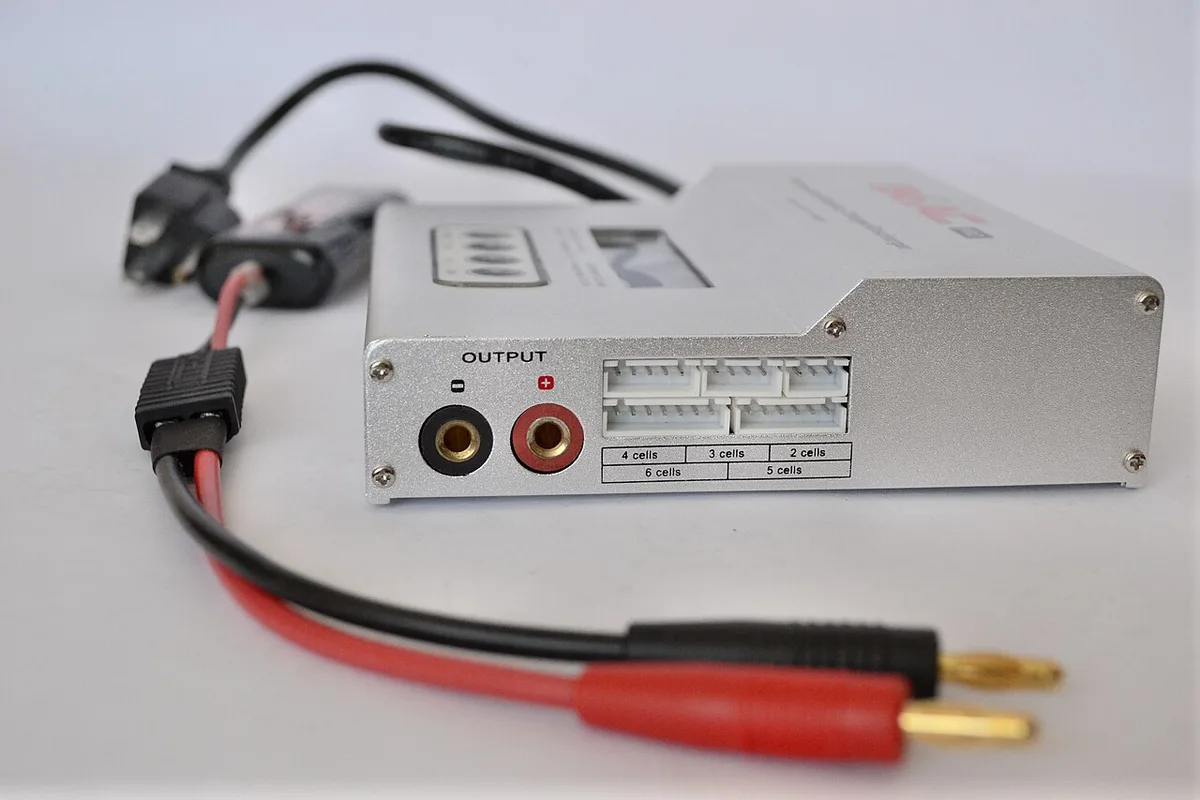
Image source: Wikimedia Commons / KundaliniZero (CC BY-SA)
Set the charger before starting:
- Select the correct battery chemistry.
- Select the exact cell count.
- Set the approved charge current.
- Connect the main leads and balance lead.
- Place the battery on a nonflammable surface.
- Start charging and confirm the displayed cell count.
- Remain nearby until charging finishes.
A 1C charge rate is a common conservative setting. For a 1,500 mAh battery, 1C equals 1.5 amps. Some packs support faster charging, but use a higher rate only when the manufacturer clearly approves it.
Faster charging creates more heat and may shorten service life.
Stop immediately if the battery becomes unusually hot, expands, smells sweet or chemical-like, or shows a damaged wire. A warm pack can be normal during charging. A hot pack is not.
If the charger displays an error, disconnect power only when safe and inspect the connectors and cell readings.
Never charge inside the drone unless the manufacturer specifically designed the system for that process. Don’t charge in a vehicle, on a bed, or inside a sealed container. A LiPo charging bag can help contain flames, but it isn’t a substitute for supervision or a suitable charging area.
For transport guidance, the Federal Aviation Administration’s PackSafe program explains current restrictions for spare lithium batteries on aircraft. Check your airline before travel because carrier rules can be stricter.
How to Store Drone LiPo Batteries Between Flights and Over Winter
Store a healthy LiPo battery at storage voltage when you won’t use it for several days or longer. The usual target is about 3.7 to 3.85 volts per cell. A 4S pack therefore stores near 14.8 to 15.4 volts across the whole battery.
| Storage situation | Recommended action |
|---|---|
| Flying again soon | Follow the manufacturer’s ready-to-fly guidance |
| Several days unused | Use storage-charge mode |
| Long winter break | Store at partial charge and inspect periodically |
| Swollen or damaged pack | Don’t charge or store with healthy packs |
Avoid storing packs fully charged for weeks. High state of charge increases chemical stress and can speed capacity loss. Don’t store them completely empty either, because self-discharge can push a weak cell into a damaging voltage range.
Choose a cool, dry, ventilated location away from sunlight and ignition sources. Avoid garages that freeze, attics that overheat, and vehicles exposed to summer sun. A stable indoor storage area is usually easier to monitor.
Keep battery terminals away from metal tools, loose screws, and other conductive objects. Protect connectors so they can’t touch each other. Store packs where they won’t be crushed by equipment or damaged by falling objects.
Inspect stored batteries periodically. Check for swelling, leakage, unusual odor, and changing voltage. If a pack has expanded during storage, isolate it from healthy batteries and follow local battery-disposal guidance.
Don’t return it to the charger to “fix” the problem.
Temperature matters during seasonal use. Cold batteries deliver less power and may show sharper voltage sag. Warm them gradually before flight, following the manufacturer’s temperature range.
After demanding flights, let the pack cool before storage charging. This reduces heat stress and gives the charger a more stable reading.
How Long Drone LiPo Batteries Last and When to Replace Them
A well-cared-for drone LiPo battery often delivers hundreds of cycles, but there’s no universal cycle guarantee. High current, heat, deep discharge, crashes, and long periods at full charge can shorten that figure. The battery’s condition matters more than its age alone.
Watch for these changes:
- Noticeably shorter flight time
- More voltage sag during acceleration
- A warmer pack after the same flight
- Slower balance charging
- Wider differences between cell voltages
- Increased internal resistance
- Physical swelling or a soft, uneven shape
A battery that once powered a five-minute flight for four minutes may now provide only two and a half. That loss can happen gradually. Sudden performance changes deserve more attention because they may indicate a damaged cell or poor connection.
Use your charger or battery monitor to compare cell readings. A small difference after charging can be normal. A persistent gap, especially when one cell remains lower after balancing, points to a problem.
Follow the battery manufacturer’s replacement threshold rather than choosing an arbitrary number.
Flight style also changes lifespan. Aggressive FPV racing draws high current and creates more heat than gentle cruising. A heavy camera drone, strong wind, oversized propellers, or repeated full-throttle climbs can raise battery stress.
Use this decision guide:
- If performance remains stable and cells stay balanced, continue normal use.
- If flight time has dropped but the pack stays cool and balanced, reserve it for lighter flights.
- If voltage sag, heat, or imbalance keeps increasing, retire it.
- If the pack swells or suffers impact damage, stop using it immediately.
A worn battery doesn’t belong on a demanding long-range flight. A conservative replacement can prevent a forced landing and protect the aircraft’s power system.
Swollen LiPo Batteries: Warning Signs and Safe Next Steps
A swollen LiPo battery is not safe to charge or fly. Puffing happens when gas builds inside the pouch, often because of overcharging, overheating, physical damage, age, or chemical breakdown.
Look for a raised center, rounded edges, stretched wrapping, or a pack that no longer fits its battery bay normally. Don’t confuse a flexible protective sleeve with swelling. The battery itself should remain evenly shaped and firm.
Take these steps if you find a swollen pack:
- Disconnect it from the drone or charger.
- Move it away from healthy batteries and combustible materials.
- Avoid bending, squeezing, puncturing, or opening it.
- Keep the terminals from touching metal.
- Contact a local hazardous-waste or battery-recycling service.
Don’t place a swollen battery in household trash. Don’t bury it, burn it, soak it in water, or leave it outside where heat and moisture can worsen the hazard. Disposal rules vary by location, so use local government guidance or an approved battery recycler.
A pack that becomes hot, hisses, smokes, leaks, or gives off a strong odor needs urgent distance and ventilation. Keep people and pets away. If fire starts, leave the area and contact emergency services.
Lithium battery incidents can intensify quickly, especially when damaged cells enter thermal runaway.
Never attempt a repair by replacing individual pouch cells. That work requires specialized equipment and controlled procedures. For most drone users, retirement is safer and more economical than rebuilding a compromised pack.
Common Drone LiPo Battery Mistakes That Cause Damage
The most expensive errors usually happen before flight. Users select the wrong chemistry, skip inspection, or assume the charger will correct every problem automatically.
Avoid these common mistakes:
- Charging a standard LiPo with a LiHV setting
- Selecting the wrong cell count
- Charging without the balance lead
- Using an unapproved charge rate
- Charging immediately after a hot flight
- Leaving a pack connected overnight
- Storing batteries fully charged for weeks
- Flying until the drone suddenly cuts power
- Continuing to use a pack after a hard crash
- Mixing batteries with different capacities or conditions
Parallel charging needs extra care. Only connect packs with matching cell counts, similar capacities, similar voltage, and comparable condition. If one battery is full and another is nearly empty, the current can flow sharply between them before charging begins.
Check every pack individually first. If one pack shows a large voltage difference or physical damage, remove it from the group. Parallel boards don’t make a defective battery safe.
Deep discharge is another frequent problem. Low-voltage warnings should prompt a landing, not a race to use every last second. Repeatedly draining cells too far can increase internal resistance and create permanent imbalance.
Clean connectors only with methods approved by the connector and battery manufacturer. Don’t spray household cleaners onto contacts. A loose or contaminated connector can create resistance, heat, and intermittent power loss.
Battery Transport, Fire Safety, and Disposal Requirements
Protect battery terminals whenever you transport a LiPo pack. Use terminal caps, individual battery bags, or another nonconductive method that prevents contact with keys, tools, coins, and other batteries.
For air travel, spare lithium batteries generally belong in carry-on baggage, not checked luggage. Airlines apply their own limits, so confirm the current rules before reaching the airport. Calculate watt-hours by multiplying volts by amp-hours.
A 1,500 mAh, 14.8-volt pack equals 22.2 Wh.
| Transport concern | Safe action |
|---|---|
| Exposed terminals | Cover them individually |
| Spare batteries | Keep them in carry-on baggage |
| Damaged or swollen pack | Don’t transport it by air |
| Airline travel | Check the airline’s current battery rules |
| Unknown watt-hour rating | Confirm voltage and capacity first |
The Federal Aviation Administration’s PackSafe guidance covers lithium-battery air transport in the United States. International flights may also follow International Air Transport Association rules, with airline-specific limits.
Keep batteries separated during vehicle transport. Don’t leave them in a parked car, especially in direct sunlight. High cabin temperatures can accelerate swelling and chemical damage.
For disposal, use a municipal hazardous-waste program, battery retailer, or certified recycling service that accepts lithium batteries. Tape exposed terminals if the service instructs you to do so. Follow its packaging rules instead of improvising.
Drone LiPo Battery Care FAQs and the Final Safety Checklist
Can you leave a LiPo battery fully charged?
You can leave a healthy LiPo fully charged briefly before flying, but long-term storage at full voltage accelerates aging. If the pack won’t be used for several days, use storage-charge mode. Keep each cell near 3.7 to 3.85 volts unless the manufacturer specifies another range.
Is a slightly puffy battery still safe to use?
No, a visibly puffy battery should not be charged or flown. Swelling indicates internal gas generation and possible cell failure. Don’t press it flat or puncture the pouch.
Isolate the pack from healthy batteries and arrange disposal through an approved lithium-battery recycling or hazardous-waste service.
Can you charge a drone battery immediately after flying?
Wait until the battery cools to a safe temperature before charging. High-current flights can leave cells hot even when the outer case feels only warm. Charging a hot pack adds more thermal stress.
Follow the manufacturer’s temperature range and inspect the battery before connecting it.
How often should stored LiPo batteries be checked?
Check stored batteries every few weeks, then inspect them before charging or flying. Look for swelling, leaks, damaged wrapping, corrosion, and changing cell voltage. A pack that expands or develops a persistent cell imbalance should be isolated immediately, even if it previously appeared healthy.
How do you know when a drone LiPo battery needs replacement?
Replace the battery when it swells, overheats, suffers serious crash damage, develops persistent imbalance, or shows severe voltage sag. Shorter flight time alone may indicate normal aging, but combine it with temperature, internal resistance, and cell readings. Don’t use a weak pack for demanding or high-risk flights.